
Greenwood Parole and Probation
Three Kansas systems are easy to confuse. Parole is supervised release from an eligible indeterminate prison sentence after a decision by the Kansas Department of Corrections Prisoner Review Board. Postrelease supervision is the required community portion that follows the prison term for many determinate sentences. Probation is ordered by a court instead of incarceration, or after a court suspends part of a sentence. These labels describe different legal paths, even when each requires reports to an officer.
A Greenwood County Jail departure may end local custody yet leave probation, parole, postrelease supervision, another hold, or a separate case in force. KASPER, the Kansas Adult Supervised Population Electronic Repository, is the public KDOC search for prison and KDOC-funded supervision records. The Greenwood County court file is the better source for district-court probation. Neither source replaces the sheriff’s release record for the actual time a person left the jail.
| Status | Who orders it | Where to verify |
|---|---|---|
| Parole | KDOC Prisoner Review Board for an eligible indeterminate sentence | KASPER, KDOC parole services, and board records |
| Postrelease supervision | Required by the Kansas sentence structure after a determinate prison term | KASPER and KDOC parole services |
| Probation | District or municipal court | Greenwood court docket, clerk, and Court Services |
| Discharge | Completion under the authority that supervises the case | Full court or KDOC record, not a jail roster |
Verify Greenwood County Supervision
Start with the last known sentence and custodian. A person convicted in Greenwood County may live elsewhere and may be supervised by another office. The Prisoner Review Board offender list expressly warns that a county of conviction is not necessarily the person’s home or return county. Search identifiers carefully, and do not infer a Greenwood supervision assignment from the conviction field alone.
- Open KASPER and search by full name or KDOC number. Compare the photo, birth information, and other identifiers.
- Use Greenwood as a parole-supervision county filter, then run a separate search for Greenwood as conviction county. The two fields answer different questions.
- Read the exact status. Parole, conditional release, postrelease supervision, incarceration, absconder, and discharge are not interchangeable.
- For court probation, search Kansas district-court Smart Search. Confirm that the case belongs to Greenwood County and review the probation order and later docket events.
- Call Greenwood County Court Services or the district clerk when the online docket does not settle the question. Ask about the specific case rather than general custody.
- If KASPER appears wrong, send the record details to KDOC’s public-record correction address. Do not substitute a social post or old news item for the live agency record.
Greenwood Probation Record Contacts
Greenwood County Court Services lists a local probation contact in the county courthouse. This office serves court probation matters. It is not the Prisoner Review Board and should not be treated as the assigned office for every parolee. KASPER also warns that some community-corrections probation events after April 21, 2021 may be absent while its systems are modernized, so a missing event calls for court confirmation.
311 N. Main Street
Eureka, KS 67045
Probation: 620-583-8156
District clerk: 620-583-8153
KDOC parole services handles parole, conditional release, and postrelease supervision. The indexed service mapping groups Greenwood with Chase, Coffey, Lyon, and Marion counties, but office assignments can change. Use KDOC’s current site to identify the serving parole office before relying on an address. For local probation, the signed court order and later docket entries remain the stronger record.
Note: A conviction-county match helps find a case, but it does not prove residence, return plans, or the assigned supervision office.
Greenwood Supervision Absconder Records
An absconder is a person whom supervision authorities report has stopped reporting or cannot be found as required. The term does not mean the person completed supervision. It also does not prove current jail custody. A warrant can lead to arrest and a revocation process, but the warrant and custody status must be checked with the responsible agency.
KASPER publishes a specific parole absconder route and a separate community-corrections absconder route. Search the route that fits the supervision type, then compare identifiers. Greenwood County’s sheriff-linked offender registry is for people covered by Kansas registration law. It is not a broad warrant or absconder list. No official Greenwood County standalone warrant list was verified.
When a KASPER record reports absconder status, use KDOC’s listed contact path. Do not approach the person. A court docket may show a filed violation or warrant, while the supervising agency can explain the current status. Those records can update at different times.
Greenwood Release Supervision Conditions
Conditions are the rules a person must follow during parole, postrelease supervision, or probation. The specific order controls. Common themes can include reporting, approved residence or travel, treatment, payment terms ordered in the case, and compliance with other laws. A general list cannot establish the duties in one Greenwood County matter. For probation, use the court’s journal entry and later orders. For KDOC supervision, use the conditions issued through KDOC and the Prisoner Review Board.
A reported violation does not by itself show the final result. The supervising office may investigate, a court may hold a probation proceeding, or the Prisoner Review Board may address revocation within its authority. Arrest, detention, and revocation are separate events. The docket or KDOC record should be read through the last filed action instead of stopping at the first allegation.
VINELink can provide a custody-change alert when a participating agency supplies the record, but it does not explain the supervision ruling. If a person is arrested on a violation, confirm current custody with the jail or prison system and confirm the legal result with the court or KDOC. This keeps a new custody episode separate from the original release date.
Greenwood Parole Hearing Records
Kansas uses the KDOC Prisoner Review Board, not a current independent Kansas Parole Board. The board determines suitability for release in eligible indeterminate cases, sets supervision conditions, handles revocation functions, and may discharge successful supervisees when authorized. Most modern determinate Kansas prison sentences lead to postrelease supervision rather than discretionary parole, so not every prison release follows a parole hearing.
The official public-comment calendar is updated by month. Its listed-offender page supplies commitment name, KDOC number, county of offense or conviction, and case or offense information. A listing means the case is in the board process. It is not a grant of parole, an actual release record, or proof of return to Greenwood County.
Under K.S.A. 22-3717, eligibility opens consideration subject to the sentence and exclusions. KDOC defines “parole” as a suitability decision subject to processing and conditions. “Continue” delays a decision or awaits information, votes, or evaluation. “Pass” denies release for a stated period. Confirm the eventual status through KASPER and KDOC because a calendar entry is only one stage.
The board does not provide a separate official public person-level decision search in the sources reviewed. Its annual report gives totals, not proof for one person. KDOC’s process description says an appeal under K.A.R. 45-200-2(b) depends on new evidence that was not available earlier and must be written. It should not be described as a broad new hearing based only on disagreement.
The official KDOC release-process page shows the terminology used in parole review.
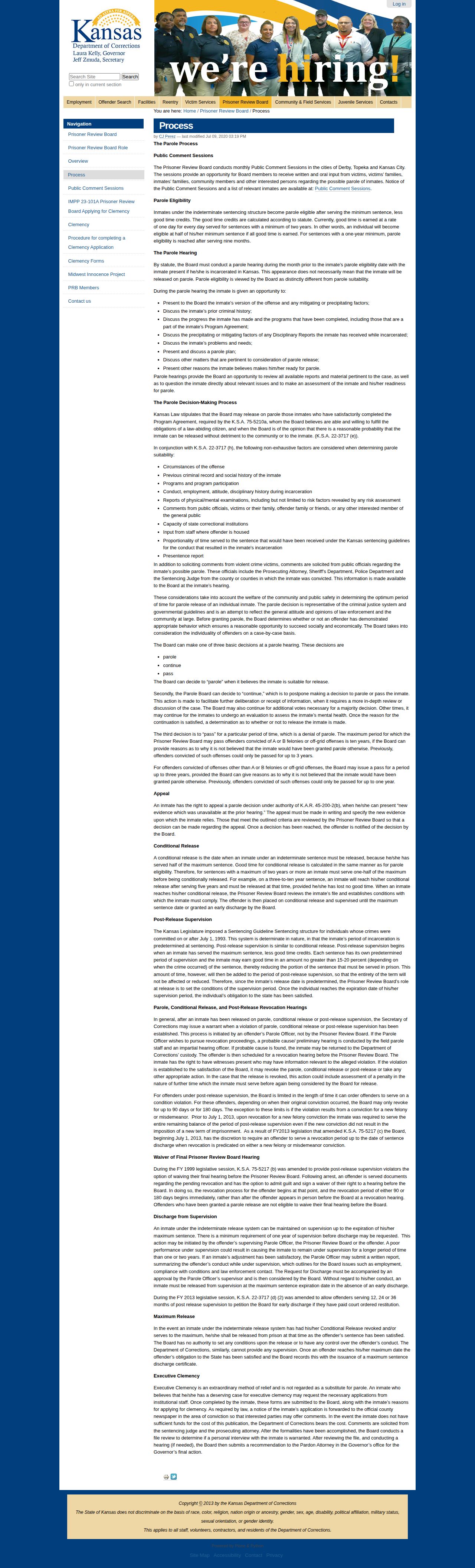
The process image helps distinguish eligibility and board action from the later custody release that must be confirmed in KASPER or with KDOC.
Greenwood Release Status Terms
The words on a supervision record describe where the person stands in a sentence. Reading the exact label helps prevent a jail release, prison release, and final discharge from being treated as the same event.
- Parole
- Supervised community release granted for an eligible indeterminate prison sentence.
- Postrelease supervision
- The required supervised part after many determinate Kansas prison terms.
- Probation
- A court-ordered sentence served in the community under stated conditions.
- Absconder
- A supervisee reported missing from required contact or location, not a person who has been discharged.
- Discharge
- The end of the sentence obligation or supervision reflected in the controlling record.
Greenwood Supervision Discharge Records
Successful completion can lead to discharge, which differs from release from prison to supervision. The Prisoner Review Board may discharge successful supervisees when Kansas law permits. KASPER’s sentence-discharge or maximum concept means KDOC no longer supervises the person under that sentence. Multiple sentences, another state, a federal matter, or a new court order can still affect the full picture.
For court probation, review the Greenwood County case for an order ending probation or satisfying the sentence. For KDOC supervision, read the whole KASPER record and verify unclear status with KDOC. The Greenwood County released-inmate search and records path explains how the sheriff’s physical release sheet and court history fit beside the supervision record. Each source answers a separate part of the timeline.
An expungement question follows a different timeline. Under Kansas law, a common waiting period for eligible categories runs from sentence satisfaction or discharge from probation, community corrections, parole, postrelease supervision, conditional release, or a suspended sentence. The jail exit alone may not start that period. A discharge order or KDOC status can therefore matter long after the first release from custody.